


Customer FAQ
(Frequently Asked Questions)
About this FAQ: I may have gone overboard by answering every possible question that I could think of, but I figure the more my customers know, the better. Skip over whichever questions don't interest you.
Your prices are not the best that I have seen.
My prices are competitive, but there are retailers with better prices. The largest beadsellers generally import their own beads. I am not an importer. Rather, I buy from importers, so I have to pay the importer's mark-up. Also, I haven't yet achieved a large volume of sales. As my sales increase, I may be able to lower my prices. I say "may" because wholesale prices are rising due to the weakness of the dollar, which is something I have no control over. Please note that my prices were higher when I first opened for business, and I brought them down when I realized that I was charging too much.
So the question remains, why should you buy from me? I carry some beads that I haven't seen elsewhere, and I think that I have good taste in selecting beads. For the most part, my pictures are good and allow you to see what the beads really look like. Unlike other sellers, I have what you might call a "full disclosure" policy; I always tell you about defects, and I give my honest impressions of the beads. My customer service and return policies are good. And all you have to do to get 10% off is to buy $100 worth of beads.
You say that you reduced the price of a bead, but the price doesn't look particularly low.
Let's say that, using my pricing formula, I conclude that a good price for a particular bead is $5.50 per 50 beads, but 10% of those beads are cracked. 10% off $5.50 is $4.95. Since my prices must be in multiples of 10¢, I will make the price $4.90. Right next to it, however, might be a similarly sized bead selling for $4.50 which has no defects at all. The less-expensive bead simply had a lower wholesale price. Since I can't tell you what my wholesale costs are, you need to trust me that I'm being honest when I say that a price has been reduced.
Your selection of beads isn't very large.
You are absolutely right! Unfortunately, I started the business without much capital, so my selection was small right from the start. Sales have been good but not great, so I haven't been able to build stock very quickly. Nonetheless, I am adding new styles each month. As of this writing (January, 2012), I have had about 1,200 bead styles on my site for about two years. Carrying 300 bead styles was my original goal (how quickly I surpassed it!); my new goal is to carry 2000 styles. I should point out that I don't try to carry everything – I only buy the beads that look good to me.
Why are so many of your items going out of stock?
I buy beads in small quantities, usually one mass (1200 beads). Since I don't carry a large amount of any style, they tend to run out quickly. Stocking small quantities of a large number of items increases the chance that my customers will find items they like (this is a common retail sales practice). As time passes and my business becomes more profitable, I will stock larger quantities and they won't run out so quickly. I frequently restock items, although sometimes they are no longer available.
Why is there a $12 minimum in the shopping cart?
Originally I set the minimum to $12 because I felt it was a waste of a bubble mailer to ship just one lot of beads. Since then, I have started including a packing slip in every order, and that has given me another reason for having a minimum: There is a lot of work involved in shipping even a small order, and an order that earns me just a few dollars isn't worth the work.
Can you send me a catalogue?
I don't have a catalogue. A printed catalogue would not be feasible because my stock changes so quickly. By the time the catalogue arrived from the printers, at least ten percent of the beads would be out of stock! Also, catalogues are expensive, and I am trying to keep my costs down.
Can you send me samples?
I run my business on slim profits, and sending samples costs money. Sending a few beads of a particular style ruins one lot of the beads, causing me to have to throw the remaining beads in the odds & ends jar. My pictures are good enough, I think, to give you an accurate idea of what the beads look like. In addition, the few times that I sent out samples, it did not result in a sale. If you buy beads from me that you feel were misrepresented by my pictures or descriptions, I will not only refund your money, I will refund all your shipping costs.
Some beads have descriptions such as 'red jasper', 'malachite', 'lapis', etc. Are those beads actually made of stone?
The Czech manufacturers have some standard color combinations which they have named after semiprecious stones, and I have simply picked up on those names. When I first started my business, I would describe them like this:
6mm blue lapis glass beads
But now I do it like this:
6mm 'blue lapis' beads
If you see quotation marks, that means that the words in the quote are merely descriptive, and that the beads are not really semiprecious.
However, if I use the term in a descriptive way, then I may not use quotation marks, like this:
6mm amethyst purple beads
6mm peridot green opalescent beads, etc.
In those cases, the words "amethyst" and "peridot" are used descriptively, so I don't use quotation marks. It can get confusing, I know. You'll know if the beads you are buying are truly semiprecious if they are in the "Semiprecious" category (although at this time I carry no semiprecious beads).
Why don't you carry more faceted beads?
I estimate that 25% of the beads I carry are faceted beads. I don't carry more because faceted beads come in fewer shapes.
Why don't you carry Swarovski crystal beads?
There are several reasons:
First, Swarovski beads are very expensive. When my business gets bigger and I have more money, I may add Swarovski beads (though it's not likely).
Second, Swarovski beads come in a huge assortment of styles and colors. In order to build up a reasonable selection of styles and colors, I would have to devote my entire bead budget to them for at least half a year, and then the other areas of my stock would suffer.
Third, there is a great deal of competition among Swarovski beadsellers, and the mark-up that I could charge would be fairly small. In other words, Swarovski beads are less profitable than Czech beads. With Czech beads, the chances that I can find a bead style that no other internet supplier is selling is greater than with Swarovski beads. That means that I can mark up the beads a little more and make a reasonable income from the business. This would seem to suggest that I am making unreasonable profits from Czech beads, but I am not. My point is that the profit that I could make from Swarovski beads would be too small to support myself.
Why don't you carry more large beads?
Large beads are problematic. First, they are usually very expensive. The amount that I have to spend to buy a mass of 15mm to 20mm beads is enough to buy four to eight mass (masses?) of smaller beads. Also, defects are more apparent on large beads. For example, a small pit on the surface of a large bead is usually more noticeable than a pit on a small bead; that's because the larger surface area of the large bead makes the pit more obvious. Cracking is also a problem. Nonetheless, when I see good large beads that aren't outrageously expensive, I get them. I just don't see that many that I like and can afford. I should add that the manufacturers don't make nearly as many large beads as small beads.
Why don't you carry more semiprecious beads?
Semiprecious beads are problematic for me because they are made under very bad working conditions in both China and India – the lapidary workers often become disabled and sometimes die prematurely from inhaling stone dust. Also, the quality of semiprecious beads is variable, and that means that I often must take new pictures, which is time-consuming. For example, I may find some good-quality sodalite on one shopping trip, but the next shopping trip the good sodalite will be gone, leaving a poorer quality. If I then get that poorer quality, I have to take a new picture. In general, I find that buying glass beads is less of a hassle.
There is now one more reason why I don't buy semiprecious beads: Because quality is such an issue, I must buy them in person, but since moving to Rhode Island I am no longer living near any semiprecious-bead suppliers.
Why don't you carry metal findings and Bali silver?
I recently decided to start carrying metal findings, but discovered that the supplier I had intended to use had moved out of the city. As soon as I find a good supplier, and have a little extra money to spend, I will start carrying findings.
I'm looking for a certain bead. Can you get it for me?
I will try to find it for you, but it's not likely that I'll succeed. Many Czech beads are made in limited runs and are available for only a short period of time. Even if the bead you are looking for is not a limited-run bead, my suppliers may not carry it. However, you should feel free to ask, and I'll do what I can.
Can you compare two beads for me and tell me if the colors match?
It takes more time to do that than you might think. I have to pull two bins from the shelves and wade through dozens of bags in each bin to find the beads you are asking about, and then I have to pull the beads from the bags to compare them. Then I have to use my judgement as to whether the beads match (and my judgement doesn't always agree with the customer's judgement). The bins weigh 10-20 lbs. each, and it is hard on my shoulders to remove them and return them to the shelves. For these reasons, I can't compare beads for you. If you get beads and the colors don't match, you can always return them. Better yet, just use them in separate pieces of jewelry.
What are job-lot beads?
The term "job lot" is fairly well known, but I'll define it anyway. Job-lot goods are goods which could not be sold through regular retail channels, either because the manufacturer made more than it could sell, the goods had defects, or the goods simply didn't sell well. Job-lot goods can also come from retailers or wholesalers who are going out of business. By definition, job-lot goods are not the most desirable items. Job-lot beads are usually plain, unattractive or defective. However, I have found some gems among job-lot beads, and in late 2004 I started to carry them.
The savings that I get from buying job-lot beads are not huge, somewhere between 20% to 40% off the normal wholesale price. Because of the weak dollar, the cost of Czech beads is going up, and this is true for job-lot beads also. I am able to pass some of the savings on to my customers, but I still have to count them and package them like other beads, so the discounts aren't dramatic. As a matter of fact, whereas normal wholesale beads usually come pre-strung in quantities of 25, 50 or 100 (so that I don't have to count them), job-lot beads almost always come loose and must be counted. Between counting them and picking out the defective beads, job-lot beads can be a lot of trouble.
Why do your pictures load so slowly?
I use large, minimally compressed pictures because I think it is important for my customers to get a good look at what they are buying. Pictures that are heavily compressed (so that they will load quickly) always look blurry.
Do you edit imperfections out of your pictures?
Sometimes I do, but it isn't because I want to deceive my customers. I am a perfectionist and I hate to produce a picture that looks imperfect. Whether or not I edit defects out of the pictures, I always give an accurate description of the defects on the bead's page. However, I am aware that if I didn't edit out the defects, it would give my customers a better idea of what the defects look like. Most pictures are not edited in that way.
Most of the fixing up that I do to a picture – cropping, brightening, adding contrast, etc. – is to make the pictures look more accurate. The pictures that come right out of the camera are often too colorful, making the beads look better than they are.
Can you sell me beads in smaller quantities, such as 5 beads of each style?
No. I wouldn't be able to make a profit selling such small quantities. Also, If you purchased just 5 beads of a particular style, that would leave me with an odd lot which I would have difficulty selling. Fifty is the minimum quantity for beads 6mm and above, except for very large or expensive beads, which are sold in lots of 20 or 25. Very small beads are sold in lots of 100.
However, I do have a jar of "odds & ends" beads which I periodically post on the site and sell. That jar contains small quantities of many kinds of beads – but you can't select which beads you get, and you may not like them all.
Instead of using the shopping cart, I'd just like to send you a list of the beads I want.
When customers email me their orders, it causes me double the work. It means that I have to construct the order myself using the shopping cart. Typing up an order manually isn't an option, so someone has to do it in the cart – if not the customer, then me. Another problem with emailed orders is that the customer often leaves out important information (such as the bead number) or requests a quantity that isn't available. For example, just before writing this information, I had a customer send me an order by email in which he requested beads in odd-sized lots (40, 70 and 80) and didn't include a single bead number. Finally, I can only accept payments through the shopping cart (taking your credit-card information over the phone and processing it manually costs me extra money), so I then have to send the customer a special link to the shopping cart, and that is more work.
Security is an additional reason why my customers must use the shopping cart. The shopping cart has fraud-avoidance features built into it. For example, a red flag will be raised if a credit-card number issued in England is used from Liberia. There is a scam being perpetrated by thieves in which they always insist that the credit-card number be run manually and not through the cart, so I have to be cautious.
I would like to add some beads to my order.
It would be easier for me if you just placed a new order. Include a note with the order that says that you would like me to combine shipment. I'll do that if the first order hasn't been shipped, and if I remember to do it (I sometimes forget). My shipping fees are very low, so you won't lose much money on shipping charges if I forget to combine the orders.
Is my credit-card information safe on your site?
Your credit-card information never gets stored on my web site or on the server where my site exists. PayPal handles all my credit-card transactions, and the information is stored on their servers. I don't have access to credit-card number. PayPal is very security-conscious, and I'm sure your information is safe. (Note: Although PayPal provides my credit-card processing services, you don't have to have a PayPal account to use your credit card on my site.)
My credit card (or debit card) wouldn't work on your site, but I know it's good.
PayPal, the company that processes my credit-card transactions, gave these possible reasons:
- One-time-use cards and gift cards are not accepted by their system.
- PayPal debit cards do not work.
- Some credit-card issuers will block transactions over a certain amount and require the customer to get prior approval before making the purchase. In such cases, all internet purchases over that amount will be declined without explanation.
- If you have a card provided by your employer, you should know that some companies do not allow their employees to make purchases on the internet. The logic here is that the company-provided card is meant to be used for travel, etc., not for purchasing merchandise from the internet.
- If your credit card was issued when you lived at another address, and you gave your current address in the shopping cart, your card will be declined. (In that case, give your old address as your billing address, and your new address as your shipping address.)
If you were not able to use your card on my site, please consider if any of these explanations are possible, and then contact me or call your credit-card issuer.
Isn't it safer to buy beads on auction sites?
Many people think it is safer to buy things on auction sites because you can leave negative feedback for the seller, but my experience is that there are plenty of dishonest sellers on auction sites, and they continue to do business despite receiving negative feedback. The truth is, it is safe to buy from most businesses on the internet. If you don't receive an item that you paid for, you can always do a chargeback through your credit-card company or through PayPal (if you used PayPal). All of the shipments I send include tracking, so you will have proof if your package didn't reach you (and I will have proof if your package did reach you). I run an honest business and I've had very few dissatisfied customers.
What dissatisfied customers have you had?
I have had a few dissatisfied customers, but mostly they were customers who were temperamental or disorganized. On a couple occasions, customers have claimed, weeks after they received their orders, that they didn't receive all the items. That's why I now ask customers to take an inventory of the items within ten days of receiving the package. Once the beads have been spread around your work area, you can't be certain whether you received them all. For a few entertaining stories about the worst customers I have had (names are not given), please go to the end of this FAQ section and read the entry entitled "The Bad Customers".
I have been ordering from you for a long time. Will you let me buy on credit?
I started giving credit to long-time customers in the spring of 2005, but the second person I extended credit to started having financial problems and never paid me the $80 she owed, so I don't give credit any more. $80 is a lot of money to me, and I still resent her for not paying.
Why don't you give a permanent discount to customers who buy a lot of beads?
That's not a bad idea. However, my shopping cart cannot be programmed to recognize individual customers and give them an extra discount, so it isn't practical. In order to give high-volume customers an extra discount, I would have to charge their credit cards separately (after I had calculated the discount) and that would add to the total volume of my work.
I have a RI tax ID number. How do I avoid paying tax?
Instead of selecting "Rhode Island" as your state from the drop-down list, select "Rhode Island (with tax ID number)".
You use "private shipping insurance". What is that?
I use a private insurance company – Shipsurance – to insure all my larger shipments. Private insurance is less expensive and less troublesome than postal insurance.
Very small shipments are self-insured, meaning that I guarantee that your beads will be replaced if they don't arrive. I charge a fee to my customers for self-insured shipments, and that fee goes into a fund that I draw on when shipments are lost.
How fast do you ship?
In two to four days after the order is placed. After I've sent out a mailing, or during a sale, the shipping time may be longer. I'd love to ship orders immediately; but Purebeads is a sole proprietorship, and I need to pace myself.
Can you expedite my shipment?
Probably not. I never pack orders out of the order that they came in. To do that would be unfair to other customers. So if you want me to mail your order today, but I have a backlog of three days' worth of orders, your order will have to wait its turn.
My shipment hasn't arrived! What will you do about it?
First, we need to wait a few weeks to make sure the shipment is really lost. At that point I will either replace the beads (if the order is under $40) or send you an insurance form to fill out (if the order is more than $40 or $50). When I receive the form, I will either send you a refund or I will ship you new beads. The insurance form is necessary so I can receive reimbursement from my shipping insurer. Although this is a long process, there is really no alternative. Customers who refuse to wait for reimbursement and who initiate a credit-card chargeback will not be able to purchase from Purebeads again.
Why don't you ship by UPS, since it's cheaper?
UPS is for packages 1 lb. and over. Furthermore, UPS is no longer cheaper than the post office. I did a comparison of a 1 lb. package going to California, and the post office was cheaper. Also, there is no UPS office near me.
I paid for 100 beads and got 98.
That was either a mistake on my part or a mistake on the part of the manufacturer. Let me explain:
If the beads you bought came loose in a bag from the supplier, then the mistake was mine (I counted the beads wrong). But if the beads you bought came from the supplier on hanks (strings tied together), then the mistake was the manufacturer's. When beads come on hanks, the strings usually have 25, 50 or 100 beads on them, depending on the bead size and style. In order to save myself time, I do not count the beads; I simply strip them off the strings. If the manufacturer put the wrong number of beads on a string, you will get the wrong number of beads in your order. Recently, for example, I got a hank of 6mm beads that had 45 beads per strand instead of 50.
If you ever find that I have shorted you on beads, just let me know and I'll send the extra beads or give you a partial refund.
You describe a bead as being 8mm, but which dimension do you mean?
If I mention only one dimension, that will be the longest dimension, regardless of how the hole runs through the bead. If the hole runs through the shorter dimension, I'll start the description with that dimension -- e.g., 6x8mm. However, in the case of some beads (such as tear drops), I mention only the length, though the hole may run through the width.
The beads you sent me are much smaller than they look on the site.
I post close-up photographs of the beads I sell, and that naturally makes them look larger than they are. The details that you can see in a close-up photograph may not be evident when you view the actual bead. It is like looking at the weave of a cloth: Close up, you can see all the different colored threads, but from a distance they all blur into one color. I believe, however, that showing close-up pictures is important so that the customer can see the condition of the beads.
I give the sizes of all the beads that I post. I expect my customers to know how big the various dimensions are – e.g., to know how big "6mm" is. It would be meaningless for me to post a scale on my site because the dimensions of the scale would change depending on the size and resolution of your monitor.
Why don't you put a coin in your pictures so I can better see what size the beads are?
It might be helpful to put a coin in each picture, but personally I think that is unattractive. It would also make it harder for me to compose my photographs. You simply need to learn what the various sizes are, and take note of the sizes of beads before you order them. There is no substitute for experience.
The beads that I got aren't as bright and rich-looking as the beads in the picture.
That's probably because I did a poor job of fixing up the picture. Also, all of the digital cameras I have owned have tended to produce pictures with colors that are too rich. It took me a while to figure that out, so some older pictures on the site are not accurate.
Here is an example of what I mean.
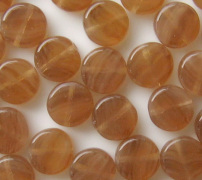 |
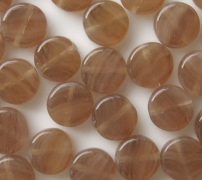 |
| This is how
the camera may make the beads look. |
This is how they actually look. |
It is also possible that your monitor is calibrated differently from mine. I have a very good monitor, but the picture may not be set as brightly as yours. Thus, beads that look correct on my monitor may look too bright on yours.
If you feel strongly that one of my pictures doesn't accurately represent the beads, please contact me to let me know. Do not hesitate to return the beads for a refund.
Some of the beads you sent me were defective.
Defective beads are unavoidable, and how to handle defects is an ongoing problem for me. Beads are non-critical items, so they aren't made to exacting standards. I do my best to select beads which don't have defects, but sometimes I end up with defective beads anyway. It is not possible for me to examine every bead that I sell. Thus, I handle defective beads in various ways, depending on the bead:
* If the percentage of defects appears to be small (5% or less), or if the defects are minor enough that many customers might use the beads anyway, and if the beads are strung on hanks, I don't make any effort to weed them out. (This is not true for large beads, however – I examine all beads 14mm and over before shipping, and I eliminate the defective ones. I also examine all expensive beads, such as window beads.) You might think that this is an unfair policy, since you will get some defective beads. However, if I took the time to eliminate all defective beads from every order, I would have to raise most of my prices.
* If the percentage of defects is high (e.g., 10% to 50%), I may choose to put the beads on sale at a reduced price. In such instances, I pass the defective beads along to the customer, who must eliminate them.
* If the percentage of defects is high (e.g., 10% to 50%), I may choose instead to sell the beads at a normal price and then include 10% to 50% extra beads with each order. In such instances, it is up to the customer to eliminate the defective beads.
Please note that sometimes it is a "judgement call" as to whether a bead is defective or not. I consider chips, scratches, cracks, large pits, black spots, and deformations to be serious defects. But I may not consider small pits, small nicks, small flat spots or color anomalies to be serious.
Having said all this, please don't forget that you are always free to return beads for a full refund. On returns, I refund your original shipping charge and pay for your return shipping.
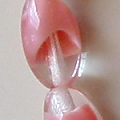
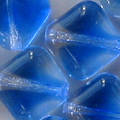
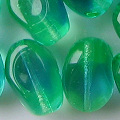
There is one defect that I don't like but which I can do nothing about: rough, frosty holes. Here are some examples:
|
Rough, frosty holes: |
|||
 |
 |
 |
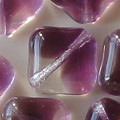 |
Do you see that the holes running through those beads are not smooth? This defect can only be seen in beads that are translucent.
The beads you sent me were dirty, and some had fingerprints.
Alas, I don't have the time to clean dirty beads before I send them to customers. Some beads pick up dirt and dust from the Czech factory to here (although most of them don't, since most of them are sealed in plastic); and in some instances, the dust might have gotten onto the beads before they were packed. As for fingerprints, you are most likely to find those on beads that have polished windows on both sides. The Czech workmen actually hold each bead up to a polishing machine, so a fingerprint is sometimes left on one side of the bead; and since the business of polishing beads is dirty work, the fingerprints sometimes look dirty. In addition to this, I sometimes put hand cream on my hands while packing the orders, and that may cause me to leave my own slightly greasy fingerprints. (I won't tell you about the times I've eaten fried chicken while packing the orders!)
There was a hair in my order – that's gross!
Yup, it happens. I am a hairy human, and sometimes a hair gets into an order. (When I had cats, cat hairs would get into the orders.) However, hairs also get into the beads in the Czech Republic, where the beads are made. More than once I have found a small clump of hair in a hank of beads (a hank is a bunch of beads strung together). Apparently, hair gets into the bead-stringing equipment, and the hair end up in knots or clumps among the beads. When I am removing beads from a hank, I don't always notice the clumps, and they end up going to the customer. However, this doesn't happen often. I estimate that one bag of beads out of 1,000 may have a clump of hair in it.
Do you ever put your beads on sale?
The only times I put my beads on sale are when I really need the money. In other words, I have no schedule for holding sales. Having said that, however, it is true that I usually hold a sale during the summer, and also in early December. I never have a sale more than once every two months – if I were to have sales more often, my customers would start waiting for them, and that would be disastrous for my business. Don't forget that you can always get a 10% discount by ordering $100 worth of beads.
You say you are concerned about the environment, but you use bubble mailers.
It is true that the plastic in bubble mailers is not good for the environment. However, it is impossible to avoid plastic altogether. Even if I used small boxes, the packing tape is made of plastic. Furthermore, destroying trees to make boxes isn't necessarily better for the environment than using plastic. The mailers that are best for the environment are mailers with shredded paper padding, but they are so heavy that they would increase the shipping cost for every order.
My theory is this: The thin plastic used in bubble mailers takes a decade or two to biodegrade. As a person who cares about the environment, I am more concerned about the large amounts of plastic used in products such as furniture, rugs, electronic equipment, automobiles, food containers, etc. Thick plastic items can take hundreds or thousands of years to biodegrade. For example, the thin plastic bag that most candy bars come in may take 10 years to biodegrade, but the hard plastic container that Tic Tacs come in may take hundreds of years to biodegrade (hint: don't buy Tic Tacs).
(Since writing this answer I have learned that plastic never completely degrades; it just breaks into smaller and smaller bits. Mankind is certainly doing a job on the environment!)
I sent you an email and you never answered me.
I believe that a small percentage of emails sent to me don't get through, either because of spam filters, internet disconnects, or other problems. I am very good at answering my mail. If I didn't answer your message, either I didn't get it, or you didn't get my reply. However, I do occasionally forget.
If your message was a friendly, chatty message that didn't require an immediate response, I might have made a mental note to answer your message when I wasn't busy, but then forgot. You should never hesitate to send me a reminder if I haven't written back. I don't want anyone's feelings to be hurt.
You are very nice. I am thinking of sending you a little gift.
Unless the gift is very little, it would be better if you didn't. I am making less than $20,000 as of this writing, and I can't afford to send gifts in return. That being the case, accepting gifts from my customers makes me feel uneasy. If anything, I should be giving gifts, not the other way around!
A customer once sent me a gift of fruit preserves along with her check. I found out that the box was from her before I knew what was in it. I sent her a message saying, "Why did you send your check in a box? The line at the post office is very long! It will take me 30-40 minutes to pick up the box!" Then, when I opened the box and found the gift, I was mortified that I had said those things. After that, nothing I said was enough to heal her hurt feelings. For this reason and others, I would prefer to keep things on a professional level with my customers.
Also, please do not send me e-cards. For fear of getting a virus on my computer, I don't open such emails.
NOTE: A large section of the FAQ page was removed from this spot and turned into its own article, "Bead Types".
How many beads are in a rosary?
Here is a graphic, courtesy of Rosarycard.com, which shows the beads in a rosary:

There are 59 beads altogether, 6 large beads and 53 small beads (all the beads can be the same size, if you wish). It is not necessary to have the connecting medal, but it's a nice touch; nor does the connecting medal have to have Mary on it, though it often does. Not all rosary necklaces have this configuration, although my understanding is that this is the most common arrangement.
Each large bead is for one recitation of Our Father, and each small bead is for one recitation of Hail Mary. If you wish, you can say the Glory Be prayer at the end of every ten Hail Marys.
Are your beads "vintage"?
That depends on how you define "vintage". If "vintage" means "out of production", then many of my beads are vintage. However, if "vintage" means "decades old", then the answer is no, my beads are not vintage. I buy a lot of beads out of old, dusty boxes, but I doubt that any of them are more than five years old.
Some sellers use the term "vintage" for any bead which is out of production. However, many Czech beads are made in limited runs, so many of the Czech beads on the market at any given time are no longer being made. But that doesn't make them vintage, as in "old".
If you are paying a premium for "vintage" Czech beads, you should stop immediately. You should buy beads based on their appearance and quality only. Don't be fooled by stories of "forgotten" Rhode Island warehouses that sat for decades full of beads. It's possible, I suppose, that some stocks of beads went unsold for various reasons, but the likelihood is that such stories are false. There is a well-known Rhode Island supplier (Wolf E. Myrow) which many people think is such a place, but it isn't. They are just a normal business specializing in job-lot beads.
How durable are beads?
That depends on the bead, although you should know that glass, as hard as it is, can be scratched and worn with use. A bracelet which is constantly knocking against objects will not wear as well as a necklace which rests against your blouse. The quality of the glass, as well as the addition of metallic pigments and other ingredients, can make the surface more or less resistant to damage.
The most durable beads are those which have all the color and other effects inside the glass. Beads with colors and affects applied to the surface are less durable. That includes:
- plastic-coated or painted beads (even if they are fire-polished after being coated)
- beads with sprayed on AB coatings
- beads with colored or metallic linings (i.e., colored paint or silver in the holes)
However, please note that some coatings are heat-sealed to the bead, and such beads should be very durable.
I am opening a bead shop and I would like to use Purebeads as a supplier.
It is important that you understand that Purebeads is a retail business. That means that my prices are at least double (and sometimes more) what you would pay to a wholesaler for the same beads. Of course, you would have to buy larger quantities from a wholesaler. Nonetheless, if you are starting a bead business, I urge you to find some wholesalers to purchase your beads from.
Where can I get beads for less money?
If you live in a town or small city, there may not be a wholesaler which sells beads at lower-than-retail prices. If there are no wholesalers in your town, using Google or Yahoo to search for wholesalers may turn up a few sites with good prices. As an example, if you want dalmatian jasper beads, search for "dalmatian jasper beads" and you'll find plenty of sites that sell them – and some of those sites will have good prices. Please note that to get beads at the lowest prices, you have to buy large quantities. I suggest you read my article on bead prices, in which I discuss the wholesalers business.
Having said that, there are a few large retailers on the internet which have good prices. They include Shipwreck Beads (www.shipwreck.com), Fire Mountain Gems (www.firemountaingems.com), and the Northern Bead Company (www.northernbead.com). You can be sure that it is painful for me to list the names of my competitors here, but I don't think my customers come to me because they don't know about those other companies. I have an interesting selection of beads, and I provide good customer service.
As for wholesalers, I just feel that I can't divulge the names of my suppliers. However, if you search the internet extensively, you will probably find them.
Last but not least, their if fierce price competition on eBay, so you'll find some good deals there.
What kind of thread and needles should I use?
There are so many kinds of strings and wires that can be used for beading. The sources that I trust say that these are good for beading:
- nylon thread (mainly for seed beads)
-
polyester thread (for seed beads)
-
gel spun polyethylene (GSP) fishing line (for seed
beads and larger beads)
-
49-strand stainless steel jewelry cable (for larger beads)
When buying thread or wire, be sure to match it to the size and weight of the beads you are using. Also, there are different kinds of nylon and polyester threads – you should read the article mentioned below to find out which ones are best.
Do not use:
- cotton
thread
-
silk thread (except for knotting pearls)
-
nylon fishing line
-
monofilament (clear) nylon thread (use fluorinated carbon thread instead)
-
tiger tail (wire)
-
Kevlar thread
A jewelry designer name Sylvia Sur has published her own article on this issue. Go to her site at http://home.att.net/~ssur/ and click on "About Threads". Since I have gotten much of my information from that article, you should read it yourself. (Sorry, that page is now gone. Too bad.)
Nylon beading thread is sold in packets with a beading needle attached, but the packets are expensive. Since beading needles can be gotten separately, there is no need to use the packets.
Two new products have come on the market since I designed jewelry 18 years ago: (1) multi-strand stainless-steel wire coated with nylon (sometimes the wire is plated with silver or gold), and (2) gel spun polyethylene fishing line. The multi-strand wires are made by Beadalon and Soft Flex (there may be other manufacturers I'm not aware of). Different people have different opinions about which is better. The fishing line is available at – you guessed it – sporting goods stores.
According to Sylvia Sur, gel spun polyethylene thread is flexible and fantastically strong. It has made quite a stir among beaders. It comes in small enough sizes to use for seed beads. Larger sizes are available for use with larger beads. Judging from what I have read on Jewelry bulletin boards, FireLine seems to be the brand of choice, at least for seed beading.
Note: If you use a super-strong stringing material, be sure that you build a weak spot into your jewelry so the jewelry will break if it gets caught. You don't want your customer to be strangled or dismembered if the jewelry gets caught on something (see my article on the home page).
You should use beading needles – they are made of thin wire and have a flexible eye which compresses when it is pulled through a bead hole. They can be gotten at jewelry supply stores. Sewing needles are completely unsuitable for beading.
Should I use gold-plated, gold-filled, or solid gold findings?
The term "findings" refers to clasps, earring hooks, metal filler beads, and other metal components in a piece of jewelry.
You should never used gold-plated beads, as the gold plating is extremely thin and will chip off sooner or later. If the plating doesn't chip off, the base metal underneath will tarnish through the plating. Not all "gold-plated" beads are plated with real gold. There is a gold-colored substitute in use, referred to as "gilt", which tarnishes quickly. I should add that gold-plated silver vermeil beads are a plated type of bead that I think is acceptable (gold plating on silver). When the gold wears off, you still have a precious metal bead left. However, I have heard that the silver can tarnish through the gold plating. Presumably, dipping the item in silver-tarnish-remover will fix that.
If your customers aren't too snobby, I recommend gold-filled beads. Those are molded beads with gold on the outside and a base metal on the inside, which gives them strength. The gold surface, being molded, is thicker than gold-plating, so it lasts and doesn't allow any tarnish to come through (at least, not for many years). Also, the bond between the gold and the base metal is stronger, so the gold won't peel off. Twenty years ago I used them exclusively and they never tarnished or showed any signs of wear. I was recently told that their life is about 20 years.
If your customers are snobby, or if you are charging high prices for your jewelry, you should use solid gold. Solid gold beads can be bought in 14 karat and 18 karat and possibly other karats. I never used either, but my impression is that 18 karat beads are softer than 14 karat and are more prone to damage. Neither of them is as strong as gold-filled beads.
How are glass beads made?
Pressed beads. To be honest, I'm not sure how pressed beads are made. I believe that the molten glass is drawn into strips and then a stamper stamps out the beads (thus the term "pressed" beads). After a bead is made, it may be faceted (cut by machine) and then fire-polished (drawn through high heat to make the surface shiny). I believe that non-faceted beads are also fire-polished, but I'm not sure. If the bead is coated, the coating may be fire-polished to bond it to the glass. As for the holes, I have heard that a needle shoots into the bead at the time that it is pressed.
Lampwork beads. Lampwork beads are made individually. The artisan creates a bead over an open flame (such as a propane torch) by melting rods of colored glass onto a mandrel (a thin metal rod). Once the basic bead is created, it can be decorated with glass of different colors, which are melted onto the surface. The bead must then be annealed (baked in a kiln) to remove any residual tension so it won't crack. When the mandrel is removed, the space that it occupied becomes the hole.
The Bad Customers
I am adding this section because I need a place to vent my frustrations about the few bad customers I have had. It is probably unprofessional of me to put this information in here, but I also think that many of you will find it entertaining.
First BC
My first bad customer was a woman who was both disorganized and abusive. She would become angry and abusive (in her emails) if she was unhappy about something. In the early days of my business, I didn't label the beads in the package (a foolish mistake), and she claimed that she didn't get all her beads (and she wasn't nice about it). I finally called her, and she was nasty on the phone and eventually hung up on me. That was partially my fault. By the time I called her, I was angry, and my demeanor on the phone was cold and matter-of-fact. She wouldn't fill out the insurance form, so she didn't get a refund.
Second BC
Shortly after deciding that I would give credit to my regular customers, one of those regular customers purchased $80 worth of beads, and then never paid for them. Her husband left her and paid her no alimony, and she was stuck in a big house with no money. I felt a great sympathy for her. However, she never paid me once she got back on her feet (which I assume she did at some point). Her debt to me was apparently just forgotten.
There was another customer who sent me a bad check, but I eventually got my money by keeping in touch with her bank. As soon as there was money in her account, I redeposited the check, and it cleared.
Third BC
This customer wanted to be given special treatment, and when I look back on it, it is astonishing just how much special treatment I gave her. Despite that, she became dissatisfied when I wouldn't push her order ahead of other customers' orders during a very busy sale in which I fell a week behind getting the orders shipped. When I finally got to her order, I emailed her twice asking if she wanted expedited shipping. She didn't answer either message, which I thought was rude. Since she had placed her order on credit, and since she didn't answer my emails asking how the order should be shipped, I didn't ship the order. Then, two weeks later, she placed another order as if nothing had happened, expecting me to give her credit as usual. But at that point I didn't feel comfortable sending her beads on credit, so I told her that she would have to pay. She "told me off" in an email, and that was the end of our relationship.
The special treatment that I gave her was extraordinary: I gave her credit. She called me frequently, and I spent a lot of time on the phone discussing her needs. I spent a lot of time searching for special beads for her. As a favor to her, I once gave her the password to my supplier's site so that she could choose the beads she wanted (and in the process she saw all my wholesale costs). And for all of this, she returned beads from almost every order – not because there was anything wrong with them, but because they didn't suit her current design needs (why couldn't she figure that out when she placed the order?). I was quite relieved to be rid of her.
Fourth BC
I had a customer who told me about six weeks after receiving her order that she didn't receive any of the rondelles she had orderede. She had placed several orders, and she wasn't clear about which order was short. Then later she changed her mind, saying that it wasn't the rondelles that were missing, but some other beads. Then she didn't return her claim form to me in time for me to get it to the insurance company, so I couldn't get reimbursed for the shortage. It was more than two months before she gave me a clear answer about which items she hadn't received. As a compromise, I refunded one-half the value of the supposedly missing items from my own pocket. She was clearly scatter-brained and didn't know what she was doing, but she would never admit that she made any mistakes. To this day I am convinced that she got all the beads that she ordered.
As a result of this experience, I now ask customers to take an inventory of the bead packets within ten days of receiving them.
Fifth BC
More recently, a customer called me up and wanted me to re-ship beads that hadn't arrived, though only seven days had passed. After we hung up, I contacted the post office and then sent her an email explaining all the things that could go wrong, and asked her to be patient. She then sent me back a note explaining to me (in detail) how I should treat my customers, giving me all kinds of advice on how to run my business. Among other things, she said that in situations like this, I should immediately re-ship the order and take the loss of the double shipment as a cost of doing business. She informed me about Priority flat-rate services (as if I didn't know about them), and told me that I should always use Priority mail because it is more reliable (it isn't). She said that my customers would be glad to pay the higher shipping fees for the extra reliability (that's not true; buyers consistently want the lowest shipping fees). She also said that my products are not so unique that customers won't take their business elsewhere if they are dissatisfied, and for this reason I should give all my customers special treatment. When that note came in, I was busy, so I told her that I would respond later. But before I could respond, she sent another note saying that she didn't want a "back and forth" about it. In other words, having told me how to run my business, she wasn't interested in hearing my response to all the unsolicited advice she gave me.
The beads arrived at her residence two days later, but not before I told her that she was self-important and presumptuous and should take her business elsewhere.
One of the upshots of this experience was that I decided to wait three weeks to reship lost orders instead of four weeks (though in one instance, a shipment took four weeks to arrive to a customer who lived right in my neighborhood). It's true that customers shouldn't have to suffer when the post office doesn't do its job, but it's also true that I am a low-cost seller with low margins, and I can't be expected to treat my customers as one would be treated by Saks Fifth Avenue or Bergdorf-Goodman. When shipments are lost or late, my customers must be patient.
Sixth BC
The most recent bad customer wasn't even a customer, since she didn't order anything. She called me up to tell me about a bead she was looking for (a turquoise faceted pony bead). I found the bead at one of my suppliers, and I placed an order for it along with two other colors that she said she might like. She also wanted a black faceted pony bead, but she said that the black bead was less important than the turquoise bead. I found the black bead at another supplier, and I told her I would order it and have it by a certain date. But then I had an unexpected expense (my monitor died), and I discovered that I couldn't place the order and also pay my rent. So I told her that she would need to wait an additional week for the black beads. However, the other colors had arrived and were available to be purchased.
Because of the delay getting the black beads, she told me that she was no longer interested in purchasing anything from me – even though she had said that the black beads were less important to her than the other colors. I wrote back expressing my dismay that after all the trouble I went to, she wasn't going to buy anything. She said that the real problem was that she didn't want to pay two shipping fees. So I offered to refund the second shipping fee; but even so, she never placed an order.
The curious thing was that she had gone to a lot of trouble herself. She had sent me a card with samples of colored cords stapled to it, and she included one of the turquoise beads that she was looking for. Having gone to so much trouble herself, and having found a dealer who was so ready and willing to help her, you would think that she would be more patient.
Out of curiosity, I searched the internet for the turquoise beads, and I found them on another site. She had complained that my price was high, yet the other retailer was charging 31% more for them.
Other Time-Wasters
There have been other people who wasted my time and never placed an order. One person had his printing company call me to request samples of various beads (they were going to glue some beads onto invitations, or something like that). I sent the samples, but never heard anything. In sending the samples, I shorted a bunch of bead lots, and the remaining beads had to be thrown into my odd-lot jar. That was when I decided to stop sending out samples.
Another recent incident actually left me with hurt feelings. I was talking to a man who was looking for crystal beads to use in a chandelier. While we were talking, I was diligently searching my suppliers' sites for the beads he wanted. I found the beads he wanted, and he was satisfied with the prices I quoted him, yet he nonetheless disconnected me midway through the conversation. At first I thought that his cell phone died, but then I realized that he had been talking to me on a land line. When I called him back, his line was busy. Later I got through and left a message, but he never called back. In other words, he had decided during the conversation not to buy anything, and couldn't just say so. What hurt was that I was trying so hard to help him, and disconnecting me was such a shabby thing to do.
Most recently, someone contacted me looking for very specific seed beads that she had bought at a local store. At my request, she sent me eight photographs of the beads, and I found them at one of my suppliers. I created a special page on my web site on which I posted 27 pictures from my supplier's site for her to look at (which took a lot of time and work). I sent her the address of the page (twice), but she never responded. If she wanted the beads so badly that she would go to the trouble of sending me photos, why wouldn't she respond when I found the beads she wanted?
Sometimes I am able to actually help someone, and I am rewarded with a feeling of satisfaction. Recently someone sent me a picture of an unusual bead that she really wanted, and I found them in 24 colors on another supplier's site. Another person was no longer able to find some large pearls that she frequently used, and I found them and set up a special order for her.
The Kind Old Boss
A woman once sent me a long weepy story about how
she had such a wonderful old boss who was so kind to her. She wanted to
honor him by giving him a gift of beads with which he could count the remaining
days of his life. The idea was that every day he would take a bead from
one jar and put it into another jar to mark that day. She apparently
didn't think out her scam very well, because the whole idea of doing such a
thing is ridiculous, not to mention macabre. Firstly, what is the point of
knowing how many days you've lived since a certain date? That information
can be gotten from any calendar. And what about the weekends, when he
isn't in the office to transfer a bead to the second jar? And what about
those days when he simply forgets to transfer a bead? Obviously, the count
would become inaccurate very quickly. Besides which, you can count your
remaining days with dry beans as easily as you can with expensive beads.
Also, as the beads in the first jar dwindled, the stress of seeing how much time
he had left (or didn't have left) might be enough to kill him – and in that way,
the beads would become a self-fulfilling prophecy.
Since her boss was such a dear person, she expected me to supply the beads for
free; but she didn't explain why it was up to me to pay for the present instead
of her. "Purebeads.com has given you these 2,000 beads so you can count
the days until you croak. Wasn't that nice of them?"
"When you die, we'll pour the beads over your body so that future archeologists can wonder about the strange burial practices of our civilization."
And why exactly was this woman talking to her boss about his impending death anyway? "How are you this morning? How fortunate you are to have made it another day!"
Obviously, the woman was hoping I would say something like, "What a lovely story! I will send you $100 worth of beads immediately!" And then she would have made 50 eclectic bracelets and sold them on eBay for $10 each. I've often wondered if she managed to scam anyone else with that story.